
BiH among the four worst-positioned countries in Europe regarding corruption status
Sarajevo, 10. February 2026. year – According to the Corruption Perceptions Index (CPI), Bosnia and Herzegovina is among the four worst-positioned countries in Europe with...
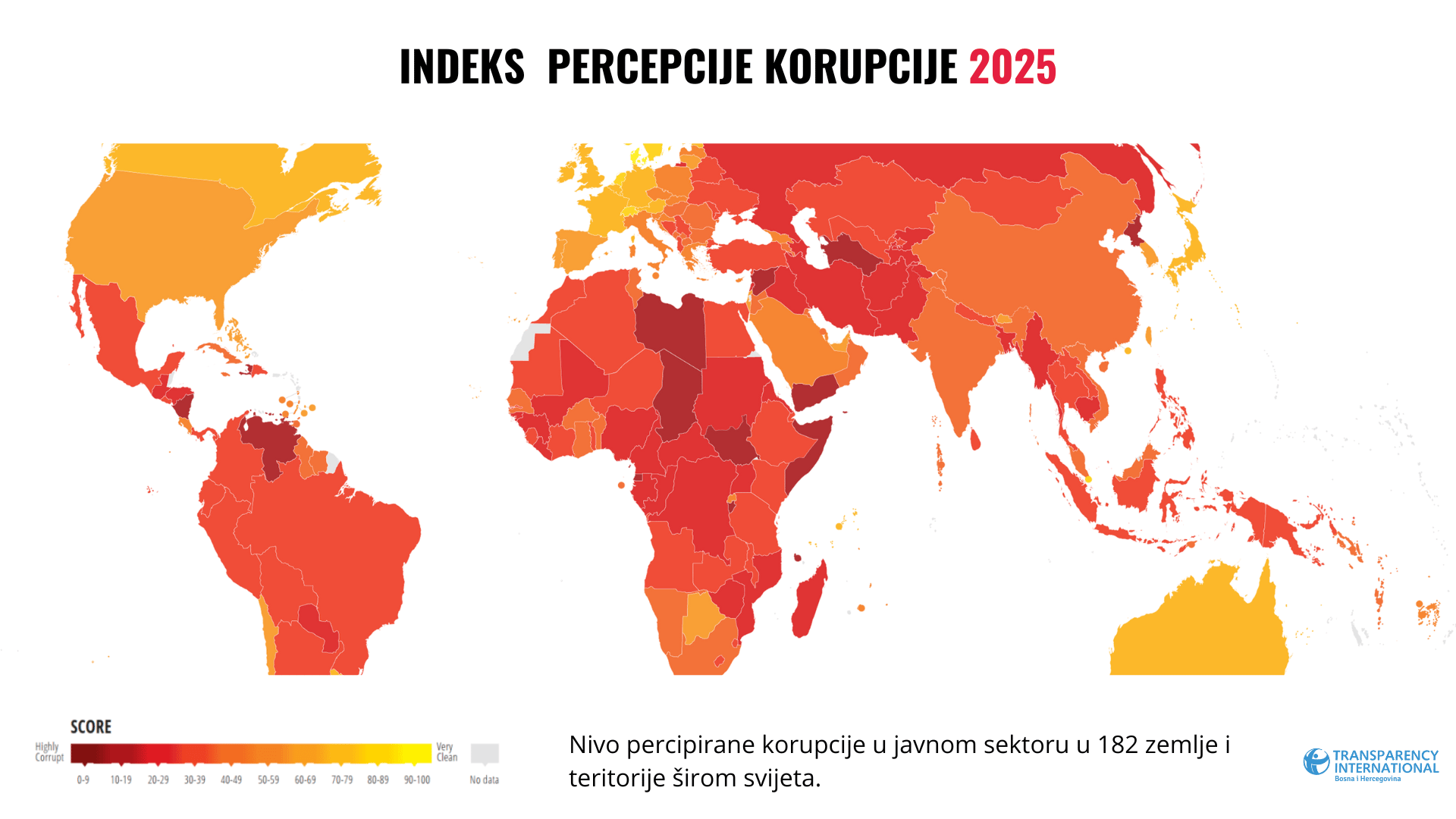
Sarajevo, 10. February 2026. year – According to the Corruption Perceptions Index (CPI), Bosnia and Herzegovina is among the four worst-positioned countries in Europe with a score of 34 out of a possible 100 and ranks 109th globally, sharing this position with Algeria, Nepal, and Indonesia. A minor change of one point higher compared to last year does not alter the picture of multi-year stagnation, as BiH remains at the bottom of Europe where only Russia, Belarus, and Serbia have worse results, with Serbia experiencing a significant decline in recent years due to the consequences of corruption on human lives and the suppression of civil liberties.
The focus of this year’s CPI research was precisely on the consequences that the erosion of democracy has on the state of corruption in a country, as countries with established democratic institutions, free media, and other mechanisms for overseeing government work more effectively combat corruption. In this regard, nothing has changed in BiH compared to previous years, as we are positioned between countries assessed as failed democracies and states bearing the label of dictatorial regimes according to the corruption status measured by CPI. This was particularly influenced by a series of laws in Republika Srpska that during the past year aimed at suppressing freedom of speech and association as well as undermining the legal order.
The global report published alongside the CPI results also focused on transparency in electoral campaign financing, which is of vital importance for protecting the electoral process from corruption. In our context, it is important to note that TI BiH research shows complete darkness prevails in this area, where parties in their latest reports concealed at least 2.6 million KM in campaign costs. In a country where the illusion of democracy prevails, authorities experiencing a legitimacy crisis increasingly seek to control the electoral process, which has been proven through the discovery of massive electoral fraud.
The regional report by Transparency International states that BiH’s progress in combating corruption is hindered by unsuccessful efforts to eliminate political influence on judicial appointments and to effectively regulate the independence and accountability of judges and prosecutors. TI BiH has already pointed to the farce currently accompanying the process of adopting the law on the High Judicial and Prosecutorial Council, where key decision-makers seek to retain mechanisms that enable political control over the judiciary.
Such BiH judiciary in a country at the bottom regarding corruption status continues to have devastating results in prosecuting corruption-related criminal offenses. In such a situation, numerous corruption scandals that marked the past year, such as the Viaduct or Pretis affairs, have not received judicial resolution.
Another critical area that remains problematic is preventing conflicts of interest among public officials, where under the new law at the state level, no sanctions have been imposed, in Republika Srpska conflict of interest has been practically legalized through arbitrary interpretations, and at the FBiH level the law has not been applied for more than 13 years. Therefore, TI BiH recently initiated, with the support of 13 parliamentarians, the adoption of a new conflict of interest law in FBiH, and the parliamentary vote could clearly show which political actors are obstructing key reforms, which is why BiH has been at the bottom of Europe for years.
With this level of corruption, BiH cannot make any steps in European integration, and the government has promised to fulfill most reforms necessary for combating corruption through the reform agenda. However, we continue to see obvious obstructions of reform processes, especially from key actors in power who are experiencing a legitimacy crisis and seek to retain levers of power by resisting democratic processes, through reshaping citizens’ electoral will and placing under political control what remains of independent institutions in this country.
Therefore, TI BiH appeals to all political actors, as well as to the EU and the international community, to provide support for the fight against corruption, as otherwise only further steps toward institutional collapse and suppression of human rights and civil liberties can be expected.
More
Read more
Get involved
Stay tuned
Subscribe to our newsletter and receive periodic notifications about our, announcements, calls and activities via email.
Don't miss it
If you want to receive our announcements immediately after the publication, leave your e-mail address in the field below.