
Banja Luka, 7. April 2026 . During 2025, the Advice and Legal Aid Centre of Transparency International in BiH (ALAC) handled 364 new cases, while 1,027 calls from citizens who were witnesses or victims of corruption were received through the toll-free hotline 0800 55555.
As in previous years, the largest number of reports concerned public administration (151 cases), confirming that employment, appointments, and management of public resources remain the highest-risk areas for corruption, according to the ALAC Annual Report for 2025 year.
A significant number of reports were also recorded in the areas of the judiciary (31), education (28), and conflict of interest (31), where a clear increase in the number of cases is evident, confirming that this phenomenon is becoming increasingly widespread and that TI BiH’s warnings about the normalization of conflicts of interest due to the absence of sanctions were justified.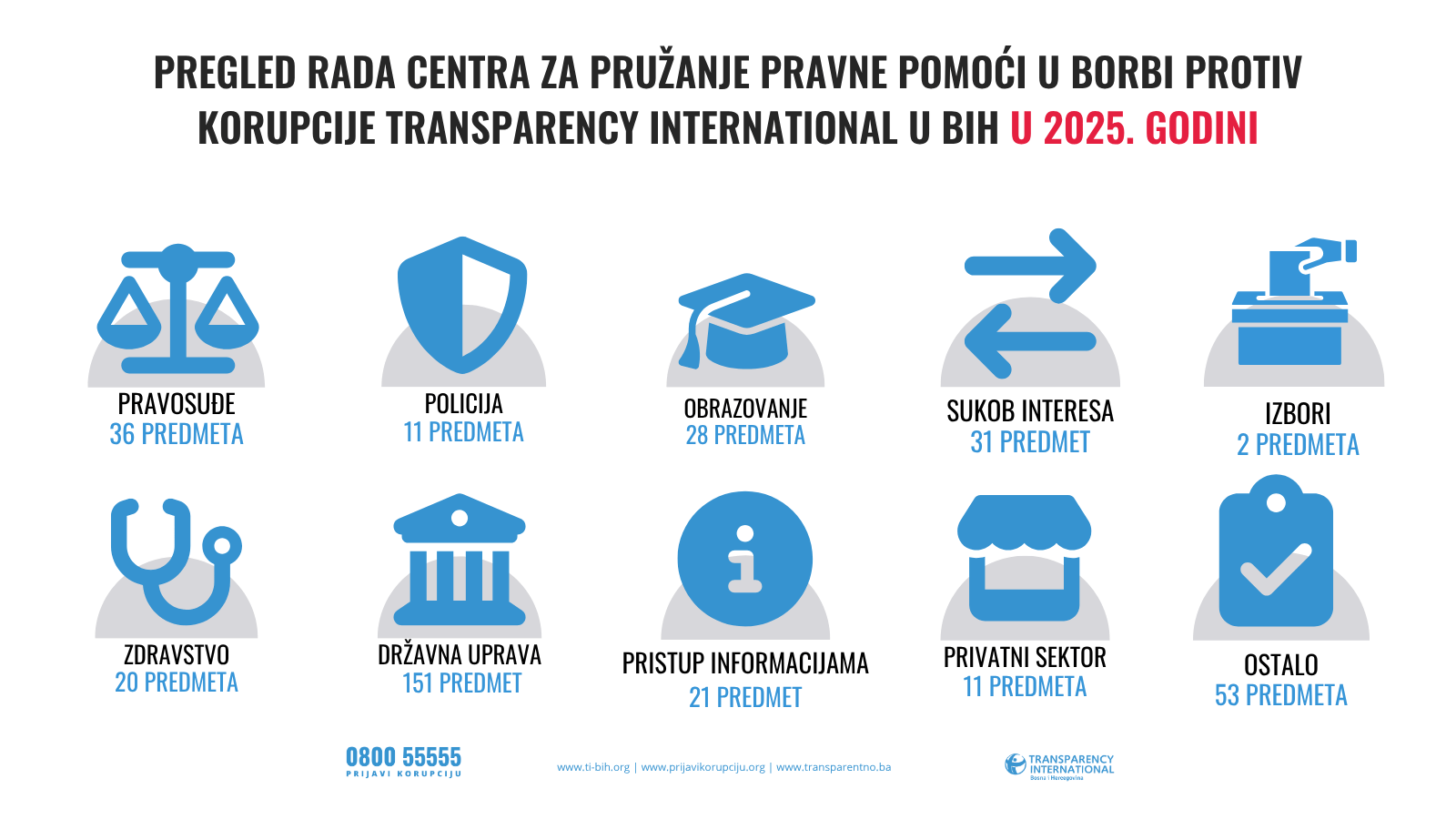
These very trends were confirmed through specific cases, as following ALAC reports, the Central Election Commission of BiH revoked the mandate of the President of the Municipal Assembly of Gacko and an advisor to the then-President of Republika Srpska, Milorad Dodik, for holding incompatible positions. During the past year, a total of 13 cases were referred to the competent institutions for action, and such examples simultaneously indicate growing awareness of the importance of integrity in the public sector, as well as serious shortcomings in the consistent application of the law.
During the year, TI BiH initiated 24 administrative disputes due to denial of access to information, while 24 cases from previous years were resolved in favor of the Centre, indicating systematic violations of this right by institutions.
The fact that the lack of transparency and accountability of institutions is an increasingly serious problem is confirmed by decisions of the highest domestic and international courts. The Court of Bosnia and Herzegovina upheld TI BiH’s lawsuit against the Ministry of Justice of BiH for unlawfully denying access to the Draft Law on the Court of BiH, thereby preventing the public from participating in the adoption process of one of the key judicial regulations.
At the same time, the European Court of Human Rights has taken under consideration cases concerning denial of access to information by the Federal Ministry for Veterans and Disabled Veterans of the Defensive-Liberation War, as well as ALAC’s application on behalf of a citizen who, despite numerous court decisions in his favor, has been unable to establish employment with the Tax Administration of Republika Srpska for several years.
In addition to insufficient openness and lack of accountability, institutions in Bosnia and Herzegovina are under increasing political influence, which is particularly evident in appointment procedures, where processes are often annulled or adapted to political interests. For example, TI BiH filed a criminal complaint against officials at multiple levels of government in the Federation of BiH for unjustified annulment of an already completed procedure for appointing members of the Management Board of the Federal Pension and Disability Insurance Institute, thereby highlighting serious abuses and political influence on institutional operations.
These cases, along with the fact that during 2025 journalists requested and received free legal assistance from the Centre 57 times, while an increasing number of cases in which citizens and media must seek judicial protection due to continuous violations of their rights by institutions, further confirm the scale of the problem.
The complex political structure, frequent blockages in institutional operations, and the absence of key legal solutions, such as the law on conflict of interest in the Federation of BiH and adequate whistleblower protection, not only significantly hinder the fight against corruption but also deny citizens fundamental rights, primarily to legal protection, employment, and access to information of public importance.
Problems such as lack of transparency, unlawful appointments, conflicts of interest, and restrictions on access to information are deeply rooted in institutions at all levels of government. Nevertheless, the work of the Centre for Free Legal Aid to Citizens through initiating administrative disputes, appeals, criminal complaints, and other legal mechanisms before domestic and European courts, as well as decisions in favor of the Centre, demonstrate that persistent and strategic legal action can lead to concrete changes.
Transparency International in BiH will continue to provide free legal assistance to citizens and advocate for the improvement of the legal and institutional framework to ensure greater transparency, accountability, and more effective fight against corruption in Bosnia and Herzegovina.
Get involved
Stay tuned
Subscribe to our newsletter and receive periodic notifications about our, announcements, calls and activities via email.
Don't miss it
If you want to receive our announcements immediately after the publication, leave your e-mail address in the field below.