Press releases

Civil society organizations Ministry of Justice of BiH: Withdraw the Pre-Draft Law on Freedom of Access to Information for processing

Civil society organizations call on the Ministry of Justice of Bosnia and Herzegovina (Ministry) to withdraw the Draft Law on Freedom of Access to Information for revision because...

Izvještaji za Mediae

Civil society organizations Ministry of Justice of BiH: Withdraw the Pre-Draft Law on Freedom of Access to Information for processing

Civil society organizations call on the Ministry of Justice of Bosnia and Herzegovina (Ministry) to withdraw the Draft Law on Freedom of Access to Information for revision because it is not in line with international standards and best practices. (more…)

In the years of the pandemic, the most reports of corruption are related to the state administration, judiciary and health

During the past year, the largest number of corruption reports received at the Transparency International Legal Aid Center in BiH (TI BiH) concerned the public administration,...

Izvještaji za Mediae

In the years of the pandemic, the most reports of corruption are related to the state administration, judiciary and health

During the past year, the largest number of corruption reports received at the Transparency International Legal Aid Center in BiH (TI BiH) concerned the public administration, justice and health sectors. (more…)

Transparency International in BiH starts cooperation with local governments in BiH with the aim of strengthening citizen participation in decision-making

At today’s conference, Transparency International in Bosnia and Herzegovina (TI BiH) presented the results of research on proactive transparency and direct participation of...

Izvještaji za Mediae

Transparency International in BiH starts cooperation with local governments in BiH with the aim of strengthening citizen participation in decision-making

At today’s conference, Transparency International in Bosnia and Herzegovina (TI BiH) presented the results of research on proactive transparency and direct participation of citizens in local government decision-making and announced the development of an online platform for consultation and communication between local authorities and citizens. (more…)

Conference on Public Procurement Held in BiH: Strengthening Oversight Key to Preventing Corruption

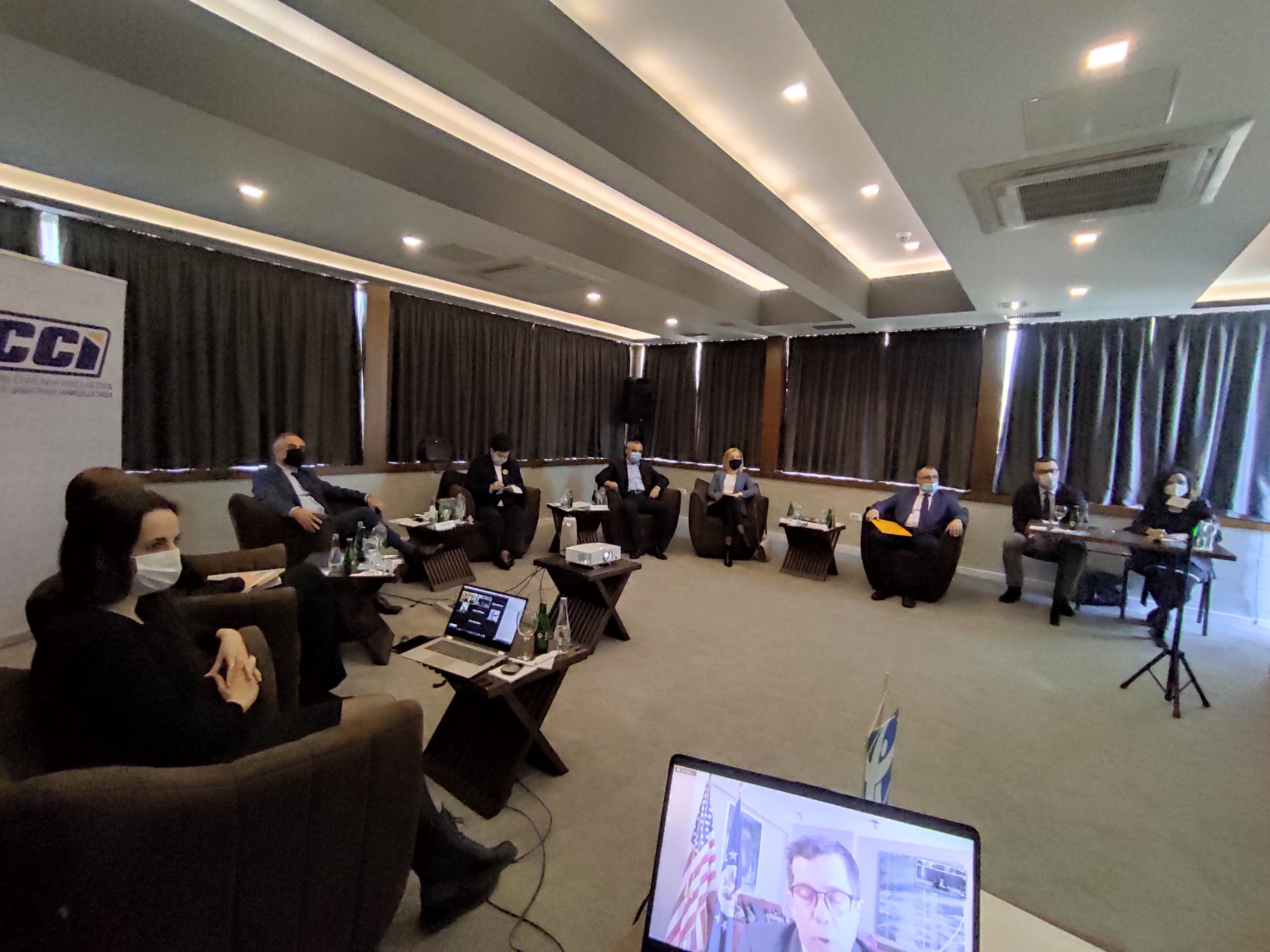
Sarajevo, 3. March 2021 – Transparency International in Bosnia and Herzegovina (TI BIH) organized a conference “Improvement of the Public Procurement System in Bosnia...

Izvještaji za Mediae

Conference on Public Procurement Held in BiH: Strengthening Oversight Key to Preventing Corruption

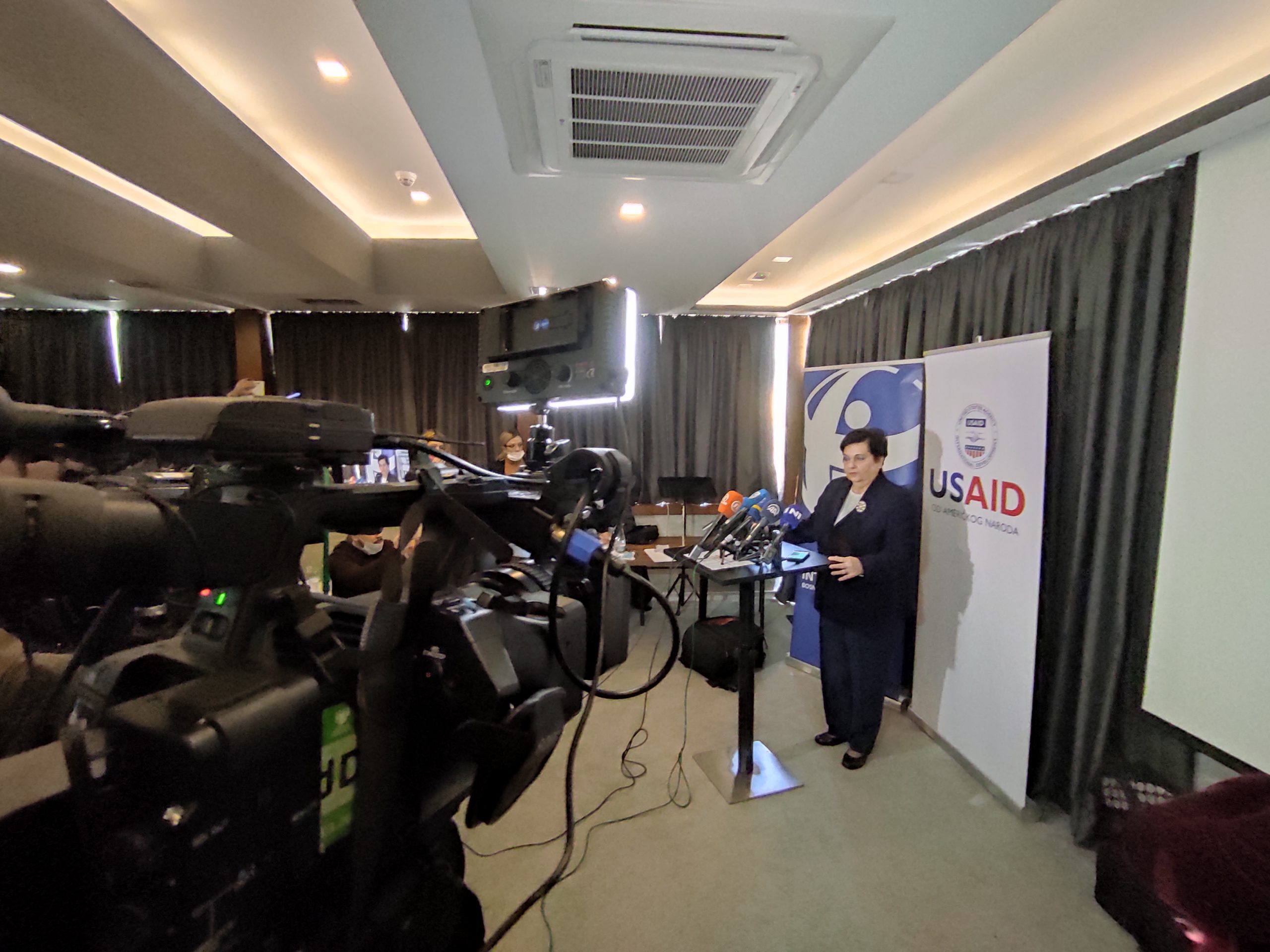
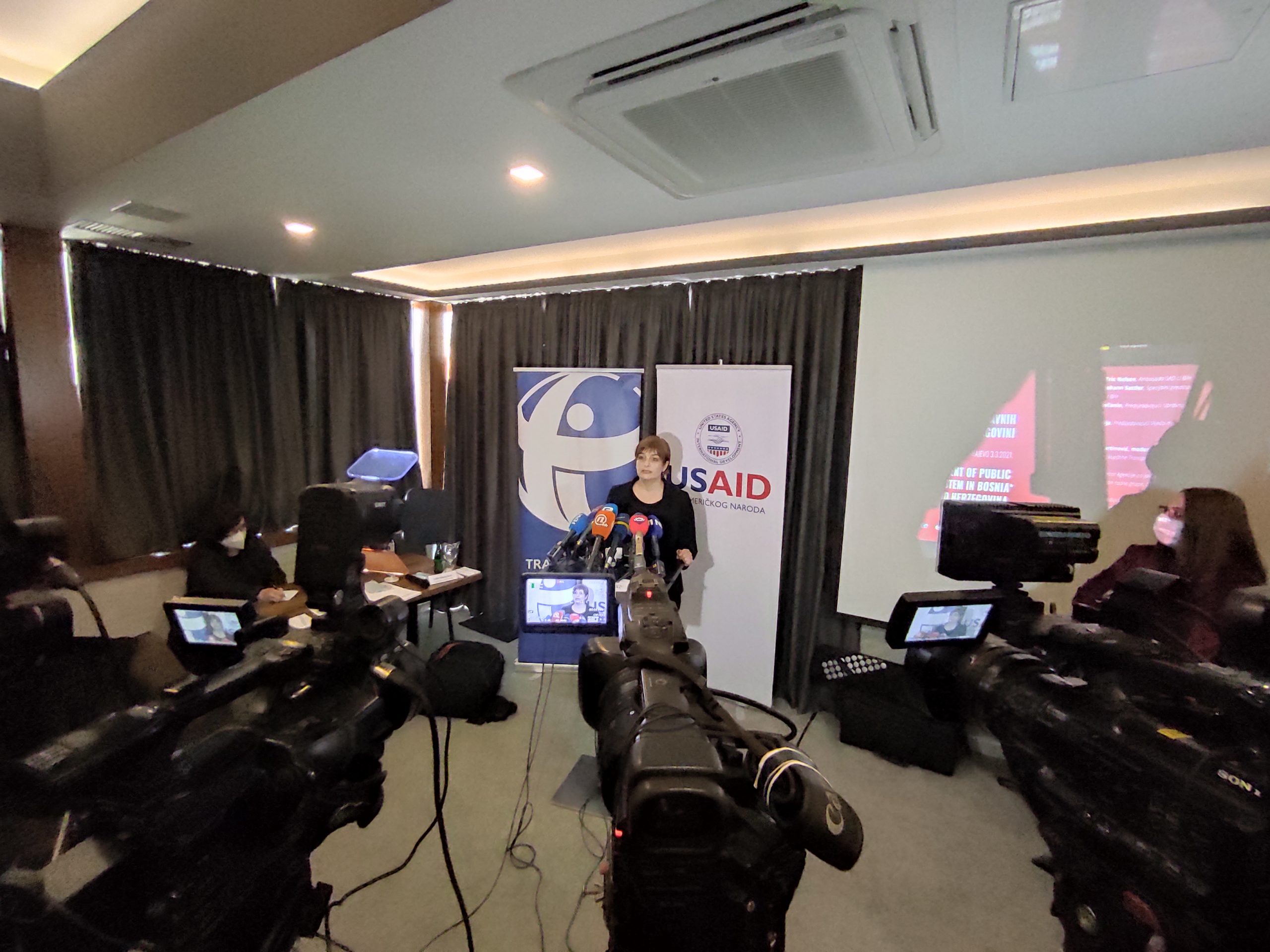
Sarajevo, 3. March 2021 – Transparency International in Bosnia and Herzegovina (TI BIH) organized a conference “Improvement of the Public Procurement System in Bosnia and Herzegovina ” on which the topic was the current proposal for amendments to the Law on Public Procurement adopted by the BiH Council of Ministers in February this year.

Transparency International in BiH welcomed the adopted changes as it started the process of improving this area, but suggested that sanctions for violating the law be tightened so that they would serve to deter actors from illegal activities. Also, TI BiH proposes to strengthen the capacity of the BiH Public Procurement Agency already now, as well as to enable mechanisms for monitoring and supervision over the entire process. In addition, there is room to improve transparency, especially those of public procurement procedures that take place under accelerated procedures. TI BiH’s proposals also went in the direction of strengthening mechanisms for the prevention of corruption and the prevention of conflicts of interest.

– Our proposal focused on increasing the transparency of the public procurement process and we insisted on strengthening the integrity of mechanisms for preventing conflicts of interest that are in line with EU directives, said Aleksandra Martinovic, chairwoman of the Transparency International Assembly in BiH.

It was pointed out at the conference that the amendments to the existing law are only the first step in the field of corruption prevention in this area in order to unblock the process of European integration, but that the adoption of a new law in the coming period is necessary.

The Ambassador of the United States of America to BiH, Eric Nelson, welcomed the efforts to improve the Law and expressed satisfaction with the inclusion of the non-governmental sector in the process. However, he stressed that BiH is the second most corrupt country in Europe, a major obstacle to the country’s progress.

More than three billion KM is spent on procurement in BiH each year, meaning hundreds of millions of marks are likely to be lost due to mismanagement, corruption and other illegal activities. That money, which comes from BiH taxpayers, could be better used to improve the lives of BiH citizens, rather than enriching corrupt officials and their friends.

Johan Sattler, Special Representative of the EU Delegation to BiH, also addressed the audience, emphasizing that a large amount of money is lost in BiH due to corruption in public procurement and stressed that the amendment to the Law on Launching BiH’s Right to EU Integration. It was emphasized that the improvement of this Law is one of the 14 key priorities identified by the European Union in its Opinion on Bosnia and Herzegovina’s application for membership.

Director of the Public Procurement Agency of BiH Tarik Rahić explained that the three key amendments to the law relate to the consolidation of public procurement plans, preliminary market checks and digitalization of the entire process according to EU standards.

The representative of the BiH Complaints Review Office, Siniša Tešanović, pointed out that the proposed changes did not offer a solution that would reduce the large number of unfounded complaints, which would improve the work of the KRC. Representatives of the BiH Parliamentary Assembly Dusanka Majkic and Predrag Kozul, as well as the Directorate for European Integration Amira Lazovic, agreed that the law could be improved by amending the parliamentary procedure.


The BiH Ministry of Justice is persistently trying to reverse the Law on Conflict of Interest

The BiH Ministry of Justice rejected two-thirds of the proposals submitted by Transparency International to BiH through e-consultations on the draft Law on Conflict of Interest....

Izvještaji za Mediae

The BiH Ministry of Justice is persistently trying to reverse the Law on Conflict of Interest

The BiH Ministry of Justice rejected two-thirds of the proposals submitted by Transparency International to BiH through e-consultations on the draft Law on Conflict of Interest. All key proposals that would lead to the improvement of this area, which is required of BiH by the European Union, were rejected, and the Ministry obviously does not give up its intention to reverse the existing law and establish even lower standards than we have now. (more…)

Civil society organizations have written to the BiH Ministry of Justice, asking for changes to the Law on Freedom of Access to Information

Public institutions in Bosnia and Herzegovina currently have no legal obligation to publish information of public interest, and the struggle of citizens, NGOs and the media to...

Izvještaji za Mediae

Civil society organizations have written to the BiH Ministry of Justice, asking for changes to the Law on Freedom of Access to Information

Public institutions in Bosnia and Herzegovina currently have no legal obligation to publish information of public interest, and the struggle of citizens, NGOs and the media to publish it often takes years. Therefore, civil society organizations in BiH sent an initiative to the competent institutions with a request to amend the Law on Freedom of Access to Information in BiH as soon as possible.

The main goal of the initiative is to introduce the principle of proactive transparency in the law, where clear standards would be established, including a catalog of information that all public institutions will have to publish on their websites. In addition, this principle envisages the consistent application of the law through strengthening the capacity of civil servants acting in accordance with the law, but also the establishment of effective supervision over compliance with the law and the introduction of sanctions for violating it.

In BiH, currently public institutions do not publish numerous information on spending budget money, public companies hide data on operations, and judicial institutions information on completed court proceedings. Most of this information should be made public, because long-term lawsuits for their delivery prevent the timely reaction of the public, which often causes damage to the interests of citizens.

Therefore, civil society organizations remind that one of the planned measures of the Strategic Framework for Public Administration Reform for the period 2018-2022 refers to increasing the availability of information where the principle of maximum transparency should be respected. Also, BiH is 2014. joined the Open Government Partnership Initiative (OGP Initiative), which is based on the idea that open government is more accessible and accountable to citizens. BiH is still 2012. ratified the Council of Europe Convention on Access to Official Documents , which encourages public authorities to publish official documents on their own initiative whenever possible, thus promoting transparent and efficient public administration.

That is why BiH civil society organizations invite authorized nominators at all levels of government, primarily the BiH Ministry of Justice, to prepare a proposal for a new Law on Freedom of Access to Information, respecting SIGMA’s principles for public administration relating to proactive transparency, as well as the Council Convention. Europe on access to official documents, and strategic commitments from public administration reform and the OGP Initiative.

The law should define the obligation to proactively publish operational information, information on organizational structure, budget and other information on the work of public authorities. A narrow range of exceptions to access to information should also be clearly defined, with a mandatory public interest test. Civil society organizations are also proposing the introduction of inspections and sanctions in case of non-compliance with legal provisions, as the current law does not have a disincentive effect on public institutions that hide information of public importance.

The initiative was signed by: Transparency International in BiH, Advisory Council of the Open Government Partnership Initiative, Association of BH Journalists, Center for Investigative Journalism, Center for Civic Advocacy, Sarajevo Open Center, UG Why Not, BH Foreign Policy Initiative, Center for the Promotion of Civil Society and the United Women Foundation Banja Luka.

Press rls_9_2_2021 – FOIA Amendment Initiative


BiH is among the countries where the state of corruption is deteriorating the most, life-threatening citizens

Corruption Perception Index for 2020 ranks BiH at 111. place of 180 countries, with a score of 35 (scale 0 -100), which is the worst score since 2012. BiH is again ranked among...

Izvještaji za Mediae

BiH is among the countries where the state of corruption is deteriorating the most, life-threatening citizens

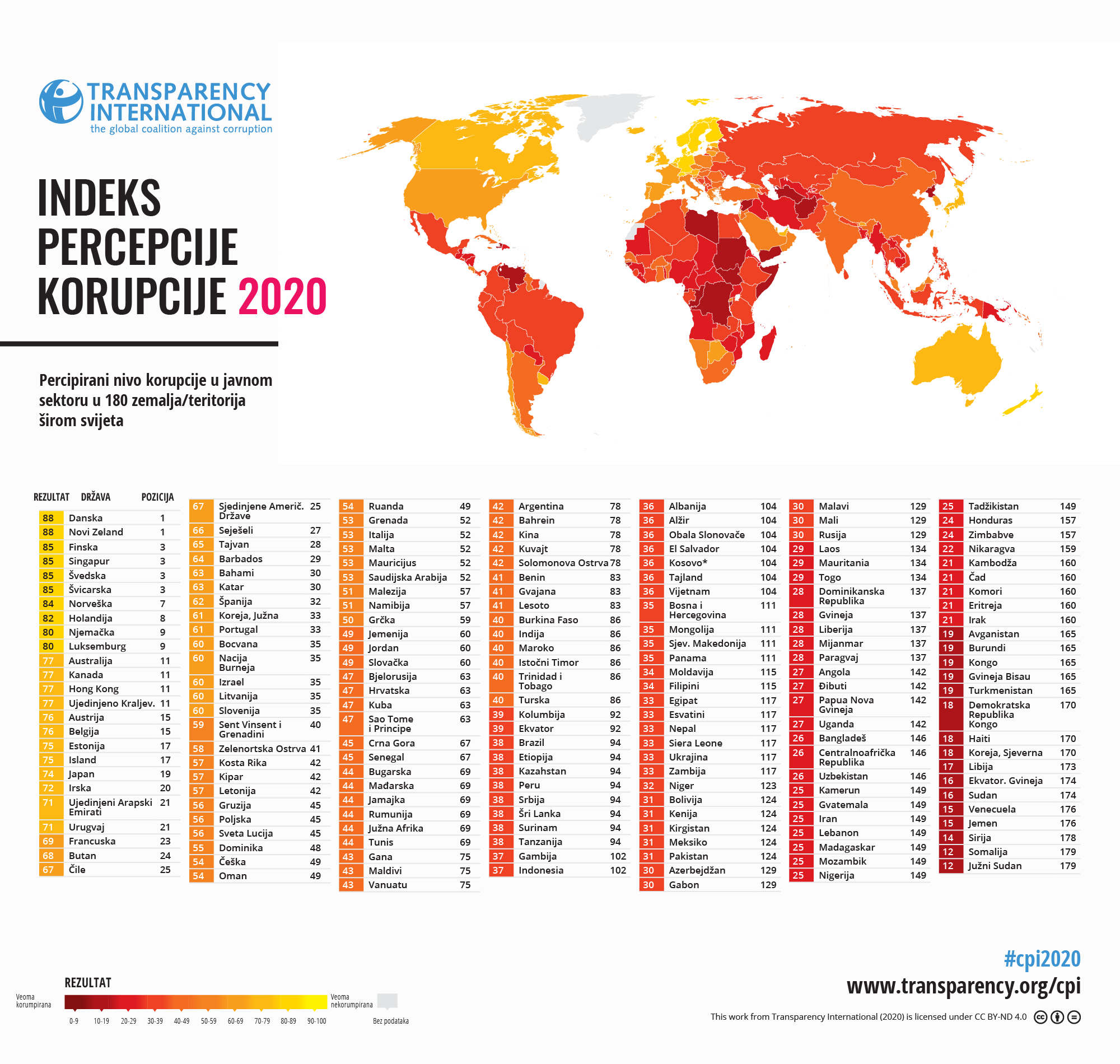
Corruption Perception Index for 2020 ranks BiH at 111. place of 180 countries, with a score of 35 (scale 0 -100), which is the worst score since 2012. BiH is again ranked among the countries lagging behind the most in the fight against corruption.

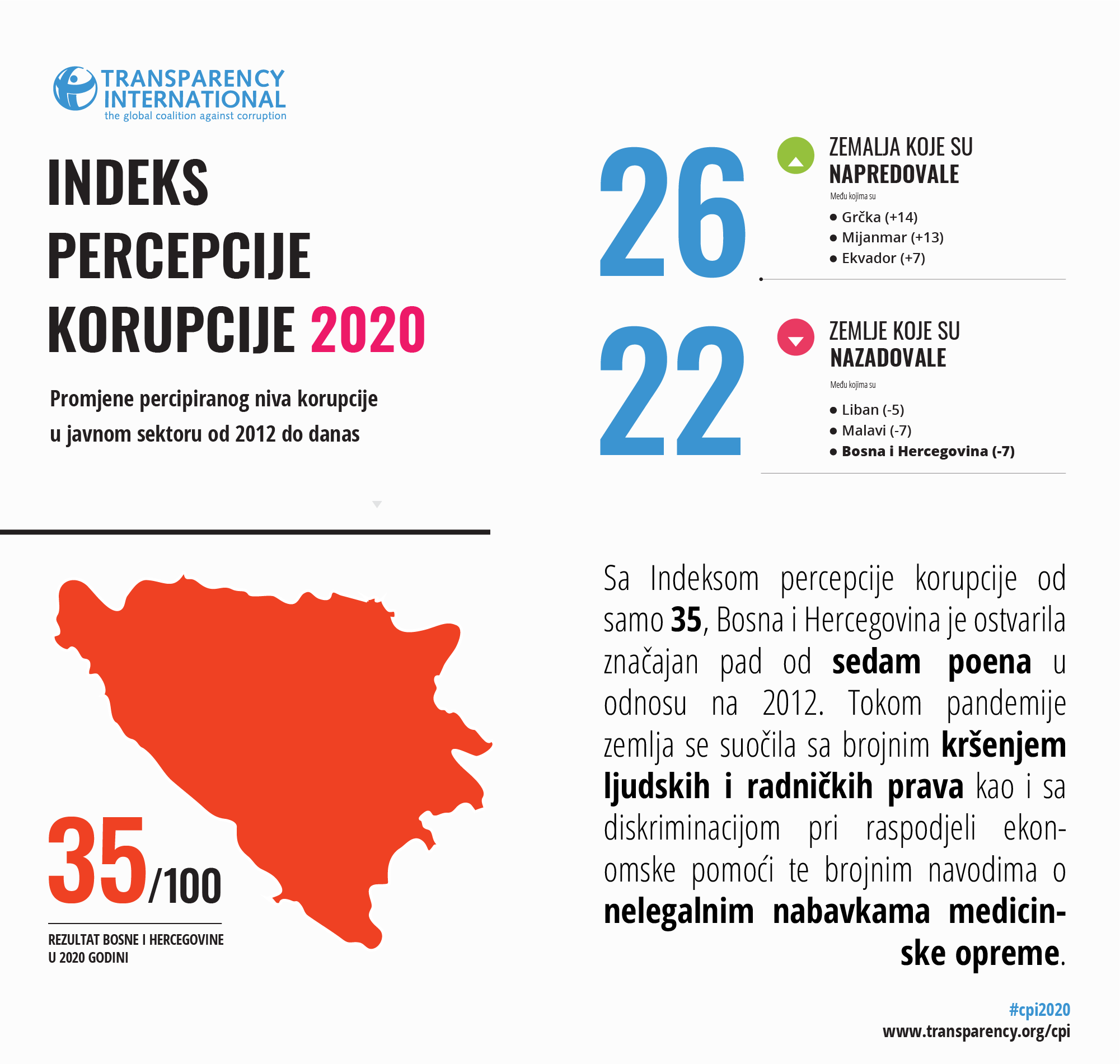
Sarajevo, January 28, 2021 – Transparency International’s Corruption Perception Index (CPI) for 2020 ranks Bosnia and Herzegovina (BiH) among the countries in the world where the state of corruption is deteriorating the most. Noting the decline of BiH by 11 places, the BiH index ranks at 111. place of 180 countries, with a score of 35 (scale 0 -100), which is also the worst score since 2012, when BiH was ranked 72nd. place with a grade of 42.

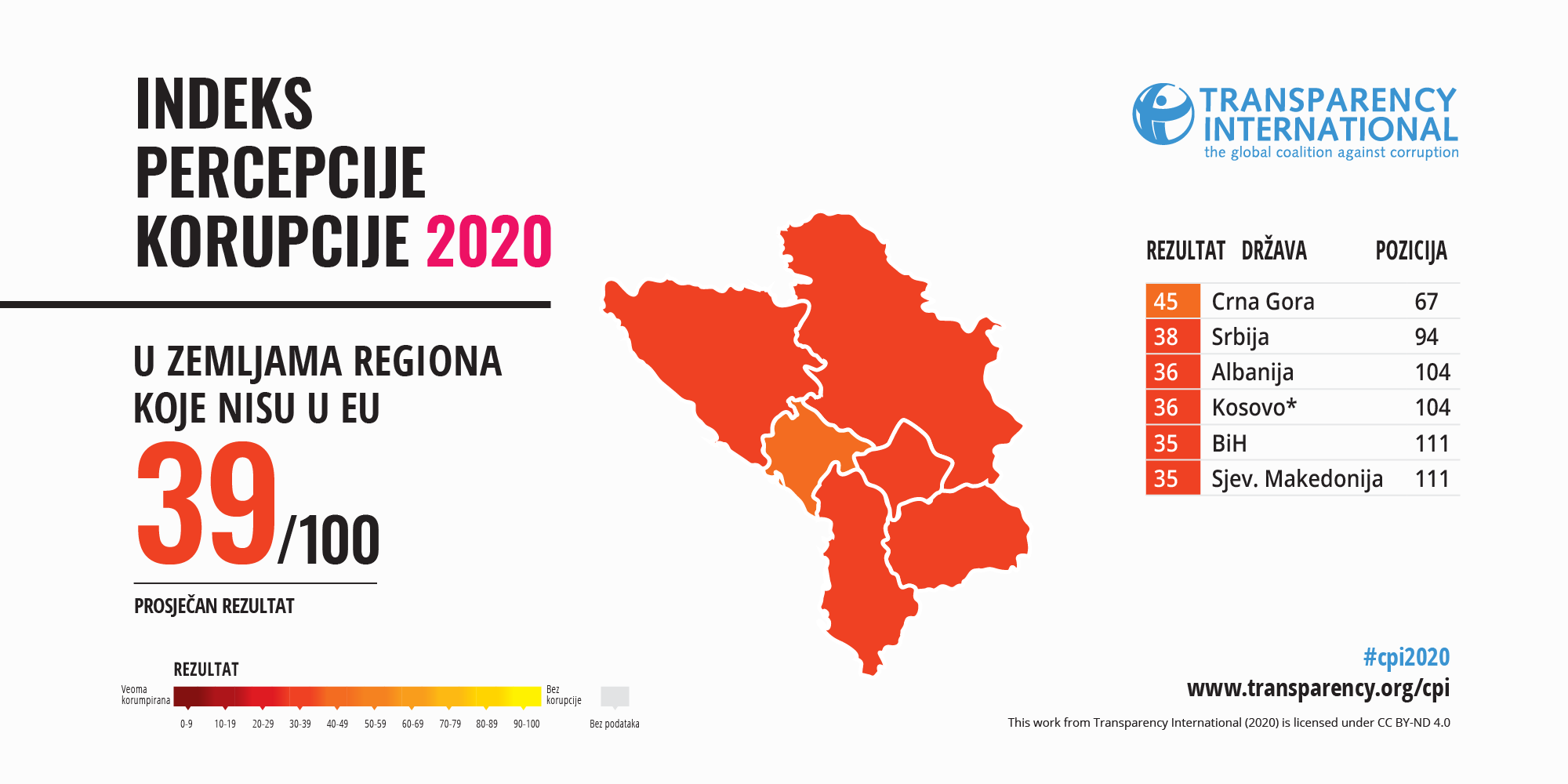
BiH is worst positioned in the Western Balkans region and shares a place with Northern Macedonia. Slovenia has the best position in the region with a score of 60, followed by Croatia 47, Montenegro 45, Serbia 38 and Kosovo 36. The best-positioned countries globally on the Corruption Perceptions Index are proverbially Denmark, New Zealand, Finland and other Western countries with a high degree of democracy. Countries affected by war, lawlessness and dictatorship are holding the ground, and this year they are Syria, Somalia and South Sudan.

Contextualizing the findings of the index, the pandemic of the COVID 19 virus undoubtedly marked the past year, but also completely exposed the darkest face of corruption, the price of which citizens unfortunately pay with their own lives. Institutions paralyzed by corruption have given priority to the unscrupulous looting of public funds, to the detriment of ensuring adequate health care. The entire period of the pandemic was marked by non-transparent and unresolved procurement of medical equipment.

These, as well as numerous other cases of corruption in which the criminal trail leads to the very top of the government, and which shook the BH public, have not received an epilogue to date, which further undermined the already almost non-existent credibility of the judiciary and public trust. Instead of an uncompromising contribution to solving the problem of corruption, the judiciary has become only the burning and biggest problem of BH society. Politically instrumental, without elementary independence and responsibility, it requires urgent and in-depth reform based on conducting detailed checks of all judicial office holders (vetting) as a first step in the fight against corruption.

BiH does not have an adequate policy or strategy for the fight against corruption, and the legal framework has been waiting for a complete and comprehensive reconstruction for years, which is unequivocally emphasized by the European Commission among the 14 priorities for obtaining candidate status. The absence of progress and direct blockade of the improvement of the legal framework for the prevention of conflicts of interest, financing of political parties, protection of whistleblowers, public procurement only confirms the complete captivity of the state and the institutional framework. The extent of the state’s captivity raises the question of the legitimacy of the BiH authorities, which is further derogated from by systemic fraud and the lack of integrity of the electoral process. During the last election campaign alone, TI BiH documented over 2,500 examples of overt misuse of public resources in the campaign.

Of particular concern is the situation in the Federation of BiH, which did not even establish a government two and a half years ago, the Constitutional Court is also incomplete, there is no legal framework for whistleblower protection, and the Law on Conflict of Interest implemented, which makes the whole situation in this entity anarchic.

“The country has been going in the wrong direction for a long time, but the COVID 19 pandemic and the economic crisis resulting from the pandemic, combined with growing corruption, could create a highly flammable mixture that could put BiH at high risk of paralysis.” , stressed Srdjan Blagovcanin, Chairman of the Board of TI BiH, at the presentation of the Index.

“In such a context, the systematic violation of human rights, the existential uncertainty of citizens, as well as the very threat to life due to the inadequate response of the authorities to the protection of public health can lead to escalating anger among citizens.”

Political parties are undoubtedly the key protagonists of capturing the state, under the leadership of undisputed leaders in whose hands real power is concentrated, they have completely controlled the public sector, subordinating it to their own needs to the detriment of the public interest.

The direct consequence of deep-rooted corruption, ie the intention to prevent disclosure of corruption and accountability at all costs, is frequent human rights violations, as pointed out by international actors, especially in the context of restrictions on freedom of assembly in Republika Srpska. European Commission. The erosion of democratic standards, the stifling of freedom of speech, the creation of an atmosphere of intolerance for voices of criticism is a long-standing trend in BiH.

Press rls_28_1_2021 – BiH among the countries where the state of corruption is deteriorating the most, life-threatening citizens

CPI 2020 Presentation

Prosecutor’s Office of BiH: Dodik’s threats to voters are not a crime

TI BiH considers it especially disputable that the Prosecutor’s Office of BiH, when considering the threat and its criminal-legal relevance, did not take into account that...

Izvještaji za Mediae

Prosecutor’s Office of BiH: Dodik’s threats to voters are not a crime

TI BiH considers it especially disputable that the Prosecutor’s Office of BiH, when considering the threat and its criminal-legal relevance, did not take into account that the threat was made by a person who is in a prominent social position and has real political power. (more…)

TI BiH welcomes the adoption of the new Law on Conflict of Interest: An Appeal to the House of Peoples to Support Improvement

The new Law on Conflict of Interest in the Institutions of Bosnia and Herzegovina, adopted by the House of Representatives of the BiH PA, is a step forward compared to the...

Izvještaji za Mediae

TI BiH welcomes the adoption of the new Law on Conflict of Interest: An Appeal to the House of Peoples to Support Improvement

The new Law on Conflict of Interest in the Institutions of Bosnia and Herzegovina, adopted by the House of Representatives of the BiH PA, is a step forward compared to the existing legal solution, as it prescribes clearer prohibitions on performing multiple functions, as well as profit and financial interest from private companies with the state. (more…)

Instead of improving, the BiH Ministry of Justice is proposing a new politicization of the implementation of the Law on Conflict of Interest

Although the improvement of the Law on Conflict of Interest is one of the 14 key priorities on the road to the EU, the Ministry of Justice is proposing a draft that in some...

Izvještaji za Mediae

Instead of improving, the BiH Ministry of Justice is proposing a new politicization of the implementation of the Law on Conflict of Interest

Although the improvement of the Law on Conflict of Interest is one of the 14 key priorities on the road to the EU, the Ministry of Justice is proposing a draft that in some provisions represents a step back from the existing one, and establishing a body that will be under political control again.

Banja Luka, December 28, 2020 – The Ministry of Justice of Bosnia and Herzegovina has sent for public consultations a draft of the new Law on Conflict of Interest of BiH, which in some parts establishes even lower standards than those we have now. Thus, BH officials are allowed to be owners or directors of private companies that receive tenders or to lead associations that receive money from the budget if the money and tenders come from lower levels of government.

Instead of the current provision of the law which says that BH officials cannot be part of the management of private companies that do business with “budget-funded institutions at any level of government”, the Ministry of Justice proposes a ban only on private companies that receive incentives from the BiH budget. BH institutions . This practically means that public officials from the state level will be able to be in the administration or be the owners of private enterprises that conclude deals at entity, cantonal and local institutions. Such a thing leaves a huge space for using political influence on institutions to realize the benefits of a private company in which the holder of public office has a financial interest.

A step back has been made in the part of the law that now prohibits BH officials from leading associations and foundations that receive money from the budget from any level of government because it is proposed that the ban apply only to associations financed from the BiH budget . Due to this situation, HDZ leader Dragan Covic found himself in trouble, because the HNS, whose president is receiving money from lower levels of government, and because of his case, the work of the Commission for Deciding on Conflict of Interest has been blocked since 2017. .

Also, if the proposal of the Ministry of Justice is adopted, not only can the blockade and political pressure on the Commission for Deciding on Conflicts of Interest continue, but its independence is not guaranteed, as it is suggested that future members may be party figures but cannot be members of the “governing body of the parties six months before the submission of the application for the public invitation for membership in the commission”. TI BiH reminds that ensuring the independence of the body implementing the Law on Conflict of Interest is one of the key international recommendations, and that it was especially emphasized through GRECO reports.

An additional problem is that the sanctions proposed for violating the law are not disincentives, because the monetary sanctions for certain violations are much lower than the possible benefits from a conflict of interest situation. Thus, for example, for violating the provisions on engagement in private companies, only a sanction of up to 2,000 KM is envisaged, while the total range is up to 10,000 KM. Some provisions are also illogical, so for example it is stated that in the case when an official who has been determined to be in a conflict of interest continues to violate the law, the commission imposes a “ban on further violations of the law “, while continuing to impose sanctions.

In some parts, the law represents progress because it stipulates that membership in the management or supervisory board of a public company is incompatible with performing a public function. However, this ban does not apply to membership in the management of public institutions, which can also lead to conflicts of interest, and the Register of Public Officials recently published by TI BIH showed that many officials run public institutions at different levels of government.

TI BIH sent comments to the Ministry of Justice on the draft stating that it does not meet international standards. Although the improvement of this law is one of the 14 key priorities set by the EU before BiH, the proposed solution represents a setback in some provisions and in relation to the existing law.

Four years ago, Transparency International in BiH initiated the adoption of the Law on Prevention of Conflicts of Interest, which is in line with international standards and assessed positively by GRECO, EU, OSCE and other international organizations, but due to numerous obstructions it was never adopted by procedures for three .

Instead of such a draft, the Ministry of Justice decided on a solution that does not meet international standards in many segments. Given that its improvement is one of the key priorities on the European path of BiH, TI BiH expects a clear message from the EU that the adoption of such solutions will not be considered fulfillment of conditions.

Otherwise, space will be opened for the BiH authorities to adopt even worse legal solutions under the guise of fulfilling their priorities, and instead of improving, they will additionally derogate from the legal and institutional framework for preventing corruption.

Press rls_13.1.2021.

Regional report on corruption in the defense system published: BiH has made progress, the greatest risk in public procurement

Banja Luka, 23. December 2020 – Bosnia and Herzegovina has made some progress in the fight against corruption in the defense and security system, but public procurement...

Izvještaji za Mediae

Regional report on corruption in the defense system published: BiH has made progress, the greatest risk in public procurement

Banja Luka, 23. December 2020 – Bosnia and Herzegovina has made some progress in the fight against corruption in the defense and security system, but public procurement remains a huge risk of corruption. This was assessed in a study published by Transparency International Defense & Security for 15 countries in Central and Eastern Europe. (more…)

TI BIH published the Register of Public Officials in BIH: 61 officials perform double functions

In Bosnia and Herzegovina, 61 officials at the state, entity and cantonal levels currently hold additional positions in institutions, public institutions and public enterprises,...

Izvještaji za Mediae

TI BIH published the Register of Public Officials in BIH: 61 officials perform double functions

In Bosnia and Herzegovina, 61 officials at the state, entity and cantonal levels currently hold additional positions in institutions, public institutions and public enterprises, and many of them are in direct or partial conflict of interest.

The Register of Public Officials presented today by Transparency International in BiH (TI BiH), which currently includes data on 763 office holders, shows that many of them hold two or three positions in the public sector where their private interests often intertwine with public ones. . These data clearly show the need to improve the law on conflict of interest, which is one of the 14 priorities of BiH on the European path. (more…)

Transparency International in BiH represents the Register of Public Officials

Transparency International in Bosnia and Herzegovina (TI BiH) will hold a press conference on 17. December at 11:00 am at the Hotel Europe in Sarajevo (Atrium Hall), where the...

Izvještaji za Mediae

Transparency International in BiH represents the Register of Public Officials

Transparency International in Bosnia and Herzegovina (TI BiH) will hold a press conference on 17. December at 11:00 am at the Hotel Europe in Sarajevo (Atrium Hall), where the first register of public office holders will be presented. (more…)

TI BiH: The state of corruption is getting worse, institutions are devastated

On the International Anti-Corruption Day, Transparency International in BiH warns that further setbacks will lead to complete lawlessness and the collapse of institutions, and...

Izvještaji za Mediae

TI BiH: The state of corruption is getting worse, institutions are devastated

On the International Anti-Corruption Day, Transparency International in BiH warns that further setbacks will lead to complete lawlessness and the collapse of institutions, and that urgent pressure must be put on reforms in the areas of justice, conflict of interest, public procurement, electoral system and political party financing. .

(more…)

TI BiH: The latest affair confirms – vetting procedures are the only solution for the judiciary

The judiciary is in a deep crisis that can only be cured by radical reform measures such as disbanding the current HJPC, introducing vetting procedures or re-evaluating all judges...

Izvještaji za Mediae

TI BiH: The latest affair confirms – vetting procedures are the only solution for the judiciary

The judiciary is in a deep crisis that can only be cured by radical reform measures such as disbanding the current HJPC, introducing vetting procedures or re-evaluating all judges and prosecutors, and enacting a set of new regulations to ensure integrity and accountability. (more…)

JOINT RESPONSE OF CIVIL SOCIETY ORGANIZATIONS: Suspension of democratic will of citizens – absolutely unacceptable

Civil society organizations from Banja Luka, gathered in the initiative The reaction , in this way, strongly condemns the announcement by Milorad Dodik, Chairman of the Presidency...

Izvještaji za Mediae

JOINT RESPONSE OF CIVIL SOCIETY ORGANIZATIONS: Suspension of democratic will of citizens – absolutely unacceptable

Civil society organizations from Banja Luka, gathered in the initiative The reaction , in this way, strongly condemns the announcement by Milorad Dodik, Chairman of the Presidency of Bosnia and Herzegovina and President of the Alliance of Independent Social Democrats (SNSD) that he will change The Law on Local Self-Government in the Republika Srpska in the sense that greater powers will be given to the parliamentary majority in local communities. The announcement comes after the SNSD president expressed his dissatisfaction with the election results regarding the election of the mayor of Banja Luka. The Reaction Initiative believes that the threats of the SNSD president by denying economic support to local communities in which the government did not provide his party are an absolutely unacceptable way of political communication, which is also characteristic of totalitarian regimes. (more…)

Get involved

Don't miss it

If you want to receive our announcements immediately after the publication, leave your e-mail address in the field below.